The Siberian Husky is
a medium size, dense-coat working dog breed that originated in north-eastern
Siberia. The breed belongs to the Spitz genetic family. It is recognizable by
its thickly furred double coat, erect triangular ears, and distinctive markings.
Huskies are a very active, energetic, and resilient breed
whose ancestors came from the extremely cold and harsh environment of the
Siberian Arctic. Siberian Huskies were bred by the Chukchi of Northeastern Asia
to pull heavy loads long distances through difficult conditions. The dogs were
imported into Alaska during the Nome Gold Rush and later spread into the United
States and Canada. They were initially sent to Alaska and Canada as sled dogs
but rapidly acquired the status of family pets and show dogs.
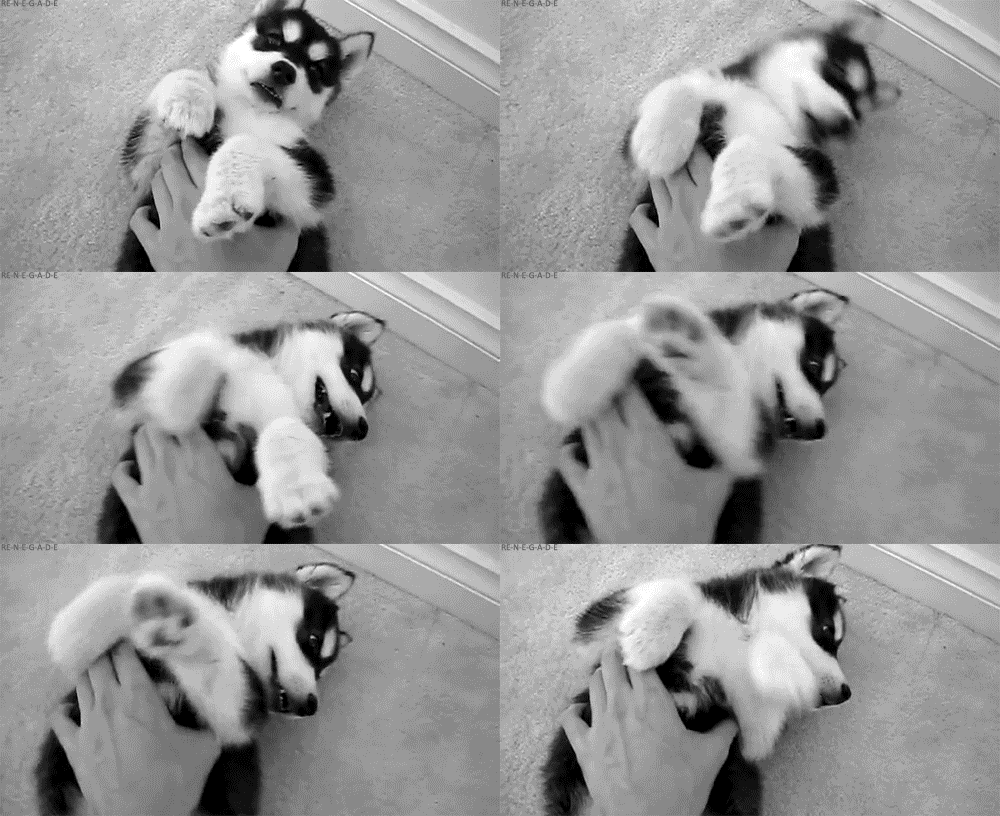
HISTORY
The Siberian Husky, Samoyed, and Alaskan Malamute are all
breeds directly descended from the original sled dog. It is thought that the
term "husky" is a corruption of the nickname "Esky" once
applied to the Eskimo and subsequently to their dogs.
Breeds descending from the Eskimo dog or Qimmiq were once
found throughout the Northern Hemisphere from Siberia to Canada, Alaska,
Greenland, Labrador, and Baffin Island.
With the help of Siberian Huskies, entire tribes of people
were able not only to survive, but to push forth into terra incognita. Admiral
Robert Peary of the United States Navy was aided by this breed during his
expeditions in search of the North Pole.
Dogs from the Anadyr River and surrounding regions were
imported into Alaska from 1908 (and for the next two decades) during the gold
rush for use as sled dogs, especially in the "All-Alaska
Sweepstakes," a 408-mile (657-km) distance dog sled race from Nome, to
Candle, and back. Smaller, faster and more enduring than the 100- to 120-pound
(45- to 54-kg) freighting dogs then in general use, they immediately dominated
the Nome Sweepstakes. Leonhard Seppala, the foremost breeder of Siberian
Huskies of the time, participated in competitions from 1909 to the mid-1920s.
On February 3, 1925, Gunnar Kaasen was first in the 1925
serum run to Nome to deliver diphtheria serum from Nenana, over 600 miles to
Nome. This was a group effort by several sled-dog teams and mushers, with the
longest (91 miles or 146 km) and most dangerous segment of the run covered by
Leonhard Seppala. The Iditarod Trail Sled Dog Race commemorates this famous
delivery. The event is also loosely depicted in the 1995 animated film Balto,
as the name of Gunnar Kaasen's lead dog in his sled team was Balto, although
unlike the real dog, Balto the character was portrayed as half wolf in the
film. In honor of this lead dog, a bronze statue was erected at Central Park in
New York City.
The original sled dogs bred and kept by the Chukchi were
thought to have gone extinct, but Benedict Allen, writing for Geographical
magazine in 2006 after visiting the region, reported their survival. His
description of the breeding practiced by the Chukchi mentions selection for
obedience, endurance, amiable disposition, and sizing that enabled families to
support them without undue difficulty.
Description
Coat:
A Siberian Husky's coat is thicker than that of most other
dog breeds, comprising two layers: a dense undercoat and a longer topcoat of
short, straight guard hairs. It protects the dogs effectively against harsh
Arctic winters, but the coat also reflects heat in the summer. It is able to
withstand temperatures as low as −50 to −60 °C (−58 to −76 °F). The undercoat is
often absent during shedding. Their thick coats require weekly grooming.
Siberian Huskies come in a variety of colours and patterns,
usually with white paws and legs, facial markings, and tail tip. The most
common coats are black and white, then less common copper-red and white, grey
and white, pure white, and the rare "agouti" coat, though many
individuals have blondish or piebald spotting. Striking masks, spectacles, and
other facial markings occur in wide variety. Merle coat patterns are not
allowed. The American Kennel Club allows all coat colors from black to pure
White.
Eyes:
The American Kennel Club describes the Siberian Husky's eyes
as "an almond shape, moderately spaced and set slightly obliquely."
The AKC breed standard is that eyes may be brown or blue;
one of each or parti-colored are acceptable: (complete is heterochromia), and
"parti-colored," that is, half brown and half blue: (partial
heterochromia). These eye-color combinations are considered acceptable by the
American Kennel Club. The parti-color does not affect the vision of the dog.
